Shift to 6th, or hold 5th gear?
For the Ferrari 296 GT3, the optimal upshift from 5th to 6th is 7350 rpm. But every shift bleeds a little speed — for a moment there's no power to the wheels and drag takes over — so right before a braking zone, holding 5th can be the faster choice. Here's exactly where the break-even is.
Data does not lie: the takeaway
Do not shift to 6th (at the usual 7350 rpm) if your braking point is less than 4 seconds away. Shifting to 6th costs ~0.86 km/h instantly and you need at least 4.3 seconds to make up that lost speed — if your braking zone is earlier, 5th gear is the fastest choice. This is valid for the Ferrari 296 GT3, under this test's conditions.
That 4-second figure is a good generic guideline — but track, conditions and setup can all shift the number. Use it as a starting point, then test with your own track / setup / conditions combo if you're chasing milliseconds. Enduro Manager's Telemetry tool will help you make the right call.
And no — holding 5th gear does not cost you fuel, despite the higher rpms. More on that at the end.
Agree, disagree? join the discussion on Discord and bring your own thoughts or data for different car / tracks / setups to share with the community.
The test
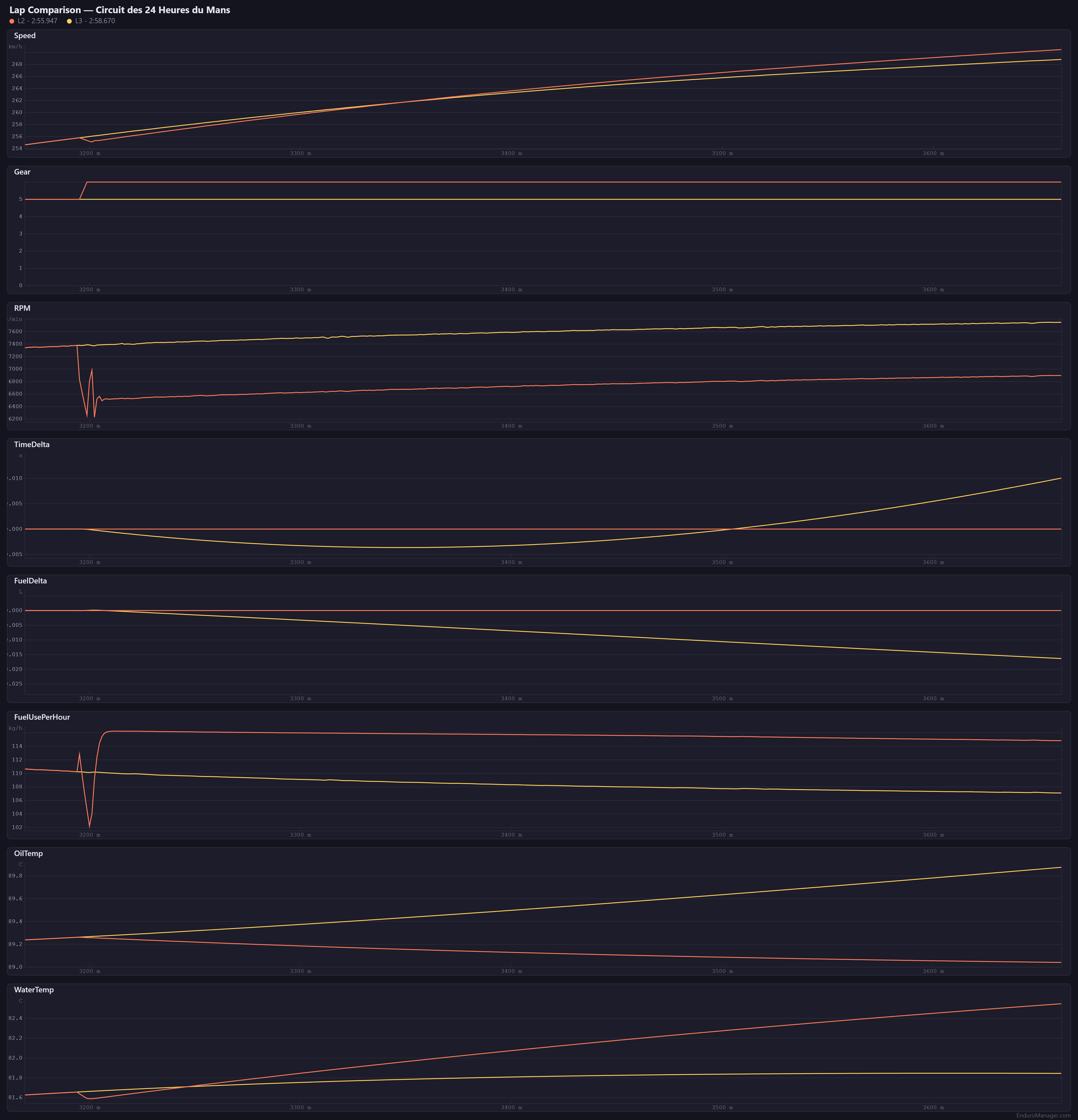
Two identical laps (using iRacing active reset), same car, same setup (iRacing medium downforce endurance), same track (Le Mans) — overlaid in Enduro Manager's Telemetry tool. One lap shifts to 6th at the optimal 7350 rpm (red, labeled L2). The other holds 5th gear all the way down the straight (yellow, L3). Note: nobody would actually hold 5th all the way down the Mulsanne straight — we picked it so that we could push 5th and 6th gears without restrictions.
The shift costs speed
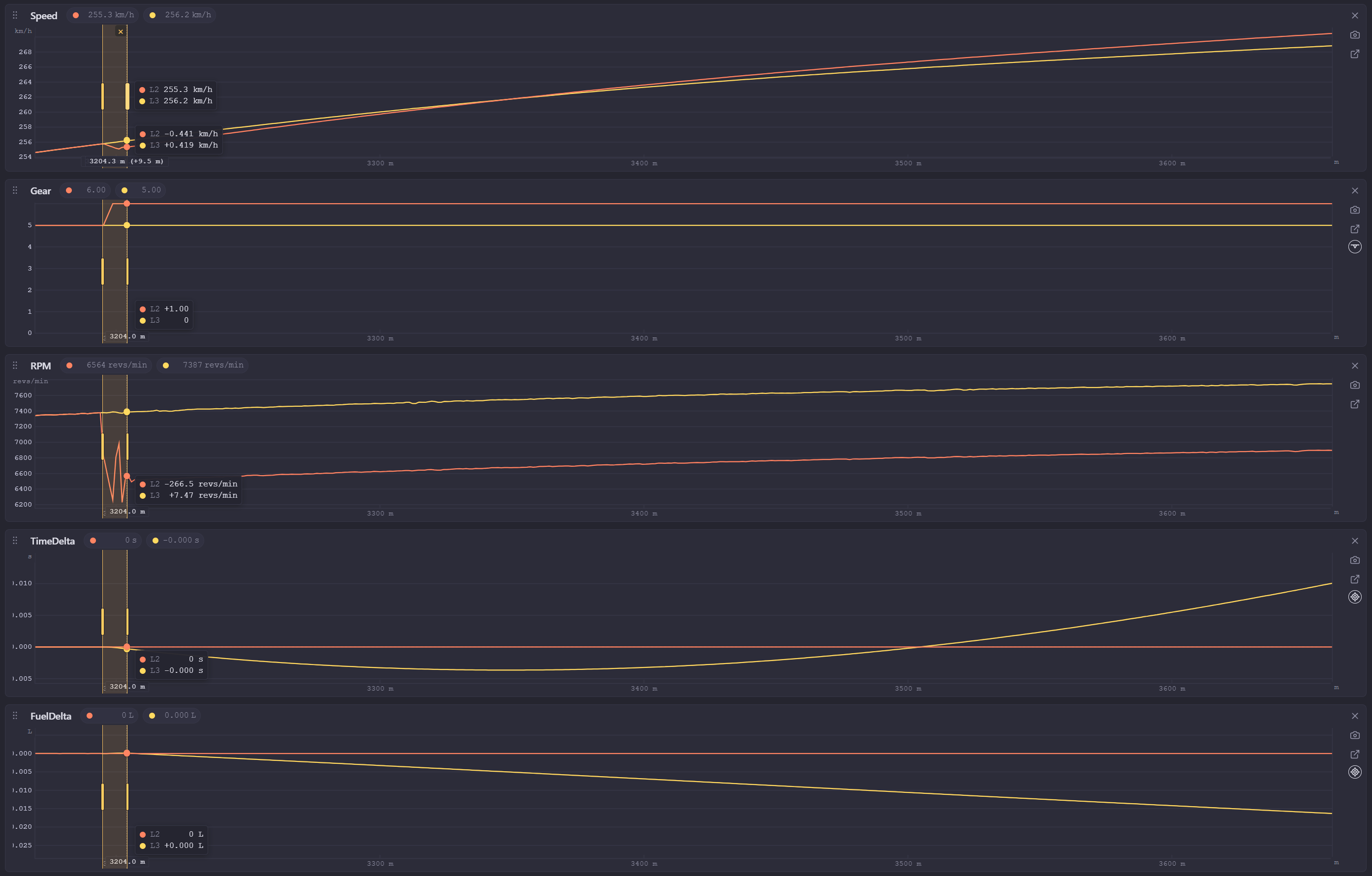
At 7350 rpm — about 255.8 km/h in 5th gear — the upshift comes with an immediate speed penalty. During the shift the engine stops driving the wheels for about 0.13 s (as measured for this 5th-to-6th shift). At ~256 km/h aero drag is high, so the car loses speed until 6th engages and power returns. During the time it takes to shift from 5th to 6th, the 5th-gear lap increases its speed by 0.42 km/h to 256.2 km/h, while the 6th-gear lap loses 0.44 km/h to 255.3 km/h. The shift comes with a net cost of about 0.86 km/h — the 0.44 you lose to drag plus the 0.42 you would have gained without shifting. That's the cost everyone feels but rarely measures.
The shift costs time initially
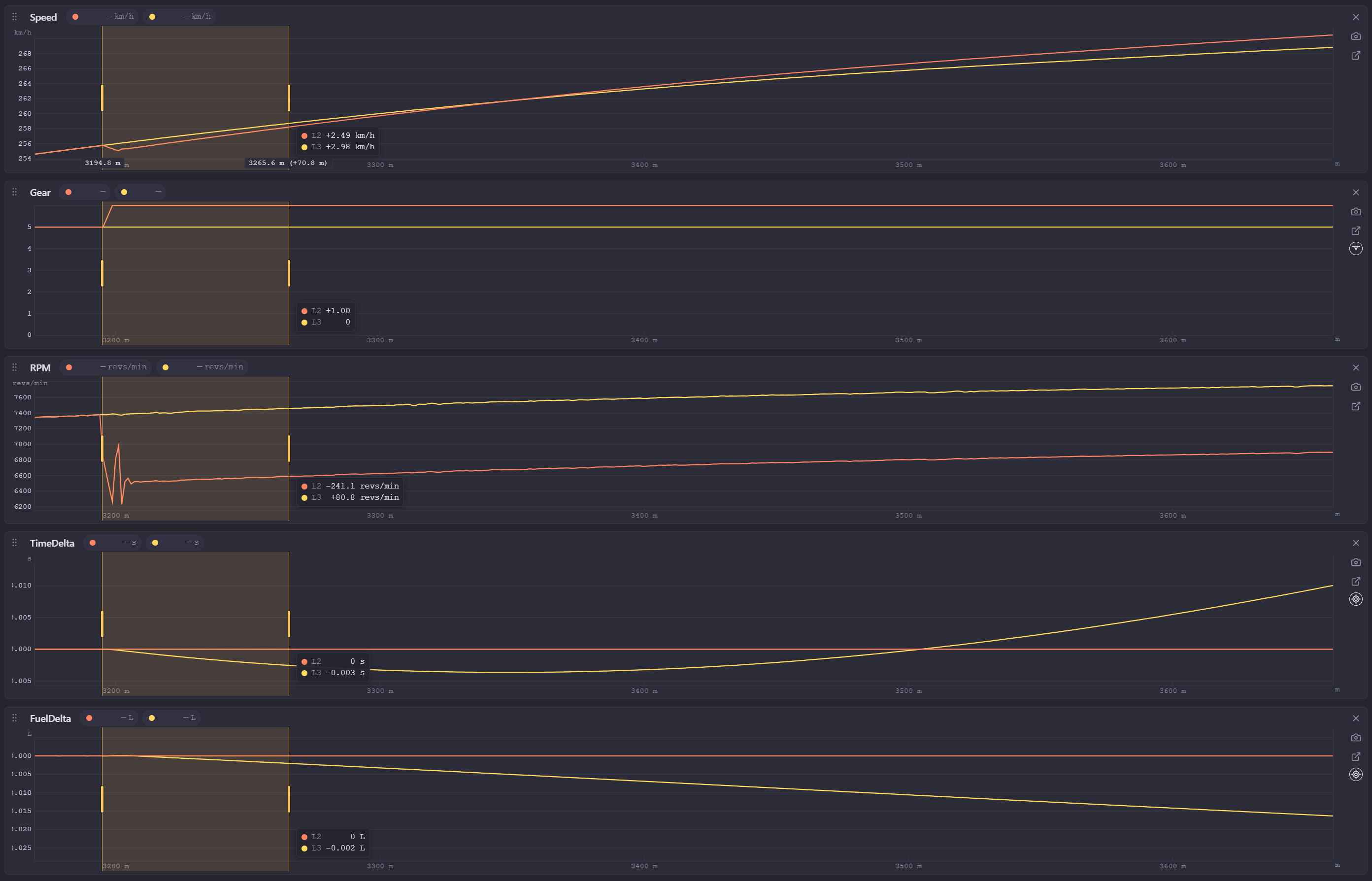
For the next stretch the 5th-gear car stays ahead. By the time 5th reaches 258.8 km/h, 6th gear is still down 0.5 km/h, and already 0.003 s behind — small, but real: 5th-gear is faster.
6th gear pulls ahead on long straights
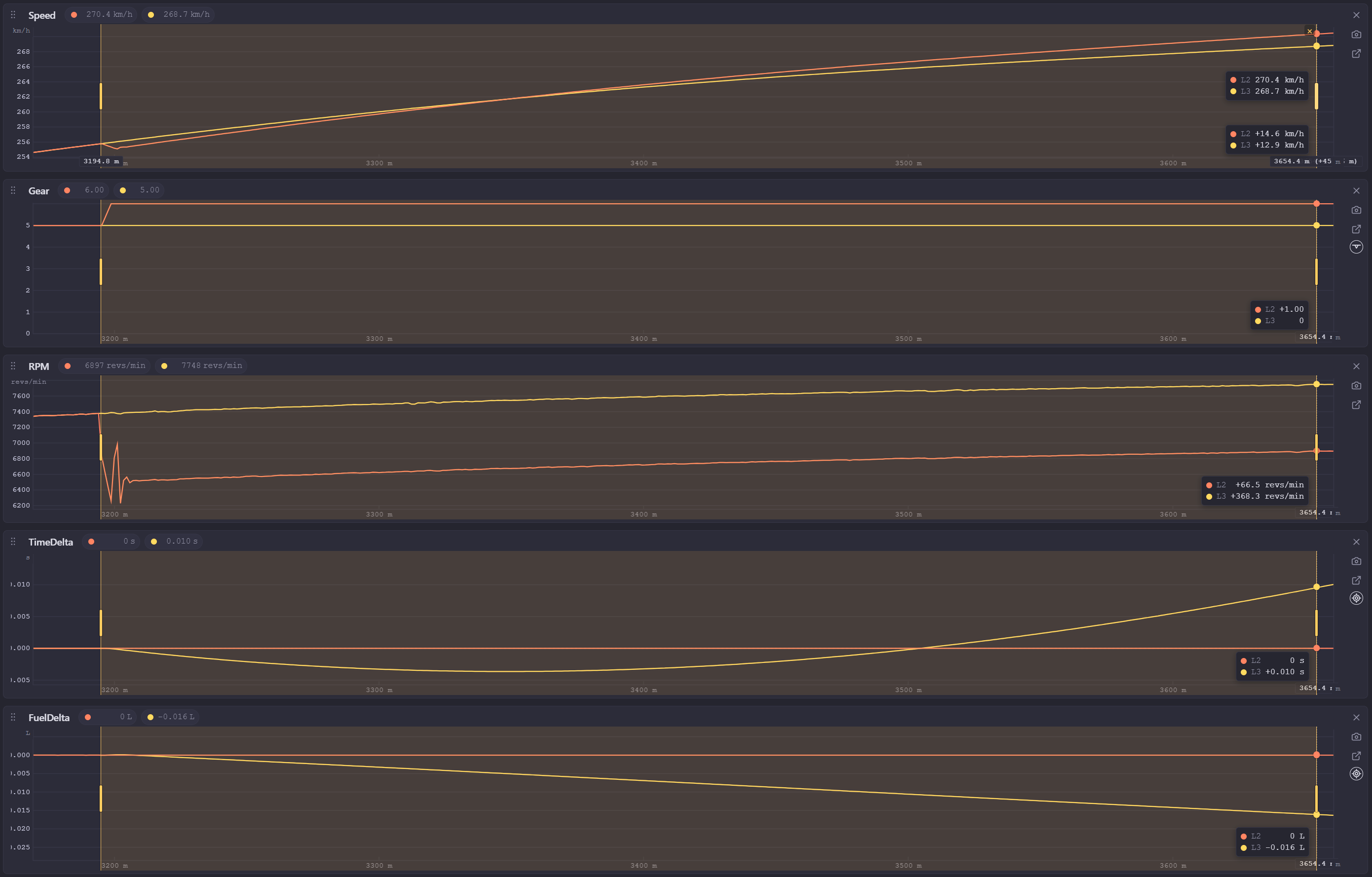
Give it enough road and 6th is the obvious choice. 5th's acceleration tails off while 6th keeps pulling, so 6th erases the early deficit and edges ahead. Later on the straight the 6th-gear lap reaches 270.4 km/h (vs 268.7 km/h for 5th) — 0.010 s ahead, and still pulling away.
So when is 5th gear the right choice?
6th gear is slower initially, and faster eventually. So when exactly is 5th gear faster? As a driver, when should you make the decision to stay in 5th gear?
Here is the data with the break-even point.
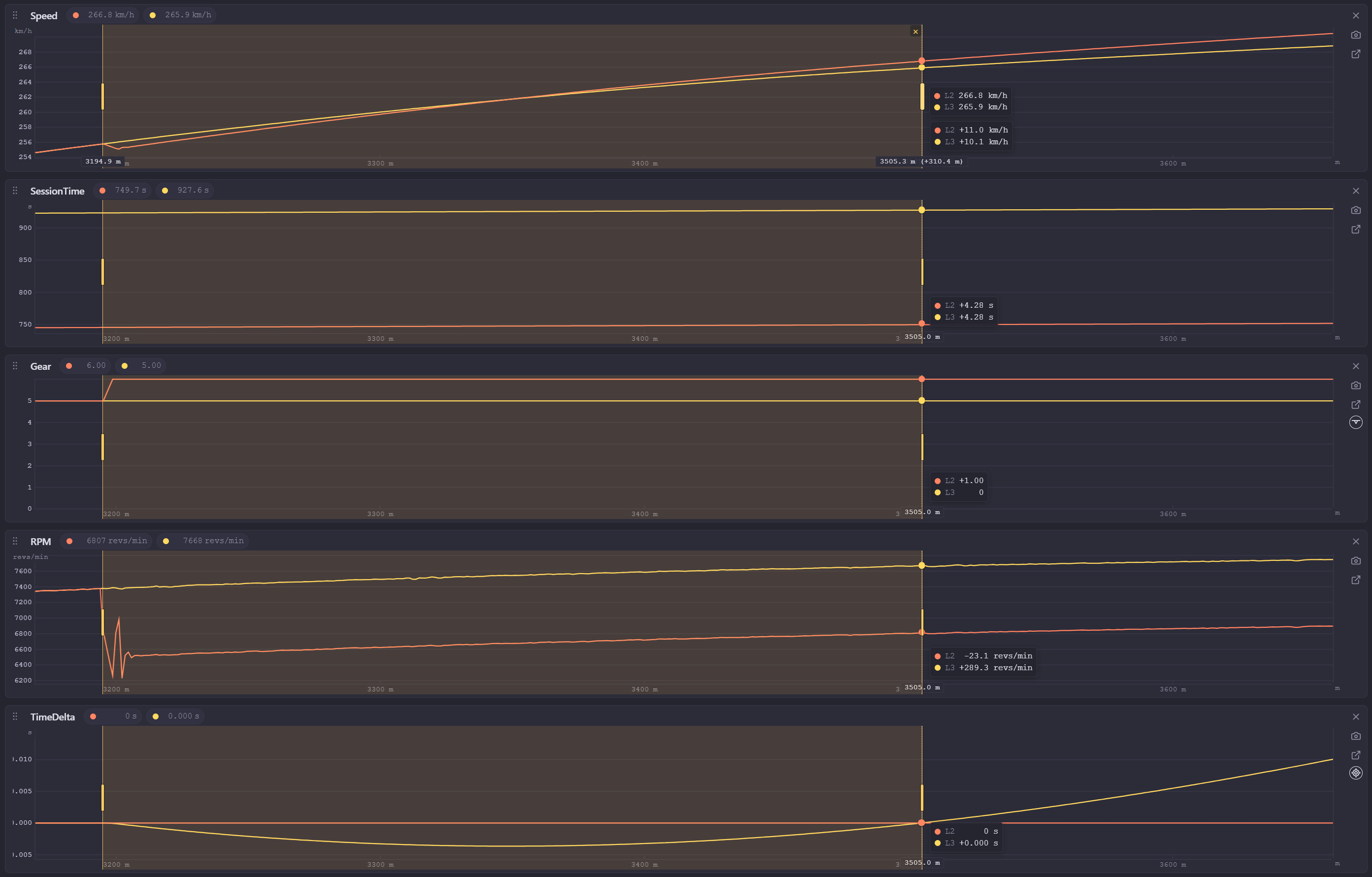
The data does not lie: in those conditions, 6th gear will only be faster if you can reach at least 267 km/h before reaching your braking point. Below 267 km/h, 5th gear stays ahead. In this test, 5th gear was ahead for 4.3 s before being caught up by 6th gear
The breakdown
Here's the whole sequence, comparing the shift to 6th gear at 7350 rpm vs staying in 5th — and what each point means if your braking zone lands there:
| Speed at the braking zone | Time | Speed | Pace | Recommendation | Comment |
|---|---|---|---|---|---|
| 256 km/h | +0.0 s | 5th is faster (+0.9 km/h) | 5th pulls ahead | Hold 5th | After the shift, 6th gear has a speed penalty |
| ~259 km/h | +1.0 s | 5th is faster (+0.5 km/h) | 5th is ahead (-0.003 s) | Hold 5th | 6th gear is slower and behind |
| ~262 km/h | +2.1 s | Level (speed break even) | 5th is ahead (-0.004 s) | Hold 5th | 6th gear just caught up on speed, but is still behind |
| ~267 km/h | +4.3 s | 6th is faster (+0.9 km/h) | Level (break-even) | Hold 5th | 6th is now faster on raw speed — but 5th and 6th break even on time. However 5th gear is still the right choice up to this point (see Q&A) |
| 270 km/h | +6.3 s | 6th is faster (+1.7 km/h) | 6th is ahead by 0.010 s | Shift to 6th | 6th gear stays the obvious choice for long straight |
The final rule
Under the exact conditions of this test (Ferrari 296 GT3, iRacing Medium downforce setup, down the Mulsanne straight): shift to 6th at 7350 rpm if you'll reach 267+ km/h before braking. Braking before 267 km/h? Hold 5th — you keep the advantage as long as you're below 267 km/h at the braking zone.
More generally — a rule of thumb: only shift to 6th (at the usual 7350 rpm) if your braking point is at least 4 s away. That's roughly how long it takes to accelerate from the 7350 rpm shift point (~257 km/h) up to the break-even speed (roughly 2.1 s to make the speed back, and 2.2 s to make up the lost ground). Track, conditions and setup shift the exact figures, but the 4 s rule of thumb holds.
The stakes are small: shifting at the usual optimal shift point will cost about 0.004 s — and that's the worst case scenario assuming your braking zone happens exactly at 267 km/h. Whether this matters is up to you!
Agree, disagree? join the discussion on Discord and bring your own thoughts or data for different car / tracks / setups to share with the community.
Q&A
Is there a fuel penalty to holding 5th at high RPM?
On the contrary, holding 5th actually uses less fuel: at high rpms, 5th gear uses ~8 kg/h of fuel less than 6th gear (107 kg/h vs 115 kg/h). By the time you reach 267 km/h, you will have saved 0.011 L of fuel. While this might not always be true in real life, this is true on iRacing. And it's consistent, keeping 5th gear at high rpms will always save fuel.

So should I shift at 267 km/h (7650 rpm) instead of the 7350 rpm optimal point?
No — 267 km/h is not a shift point, it's the speed you must reach by your braking zone that makes shifting to 6th worth it. 267 km/h is the speed after which paying the initial speed cost during the shift becomes worthwhile. 7350 rpm is still where the upshift itself is fastest; that number doesn't change. The 267 km/h figure only tells you whether to shift at all:
You either shift at 7350 or not at all — you never deliberately shift at 267 km/h, as that would be slower than either alternative.
What about engine temperature?
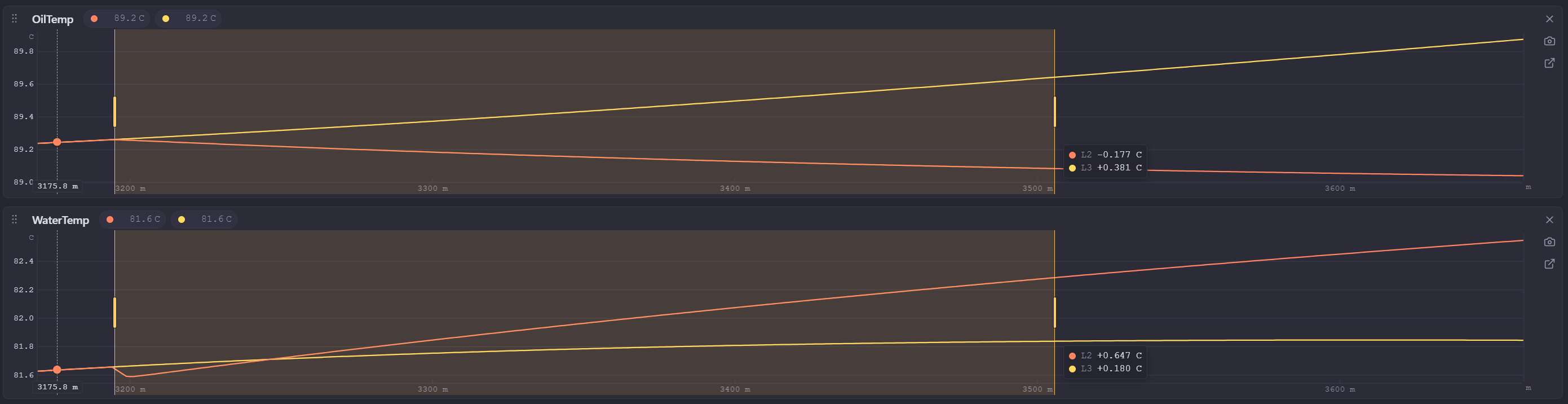
Holding 5th until reaching 267 km/h causes oil to run slightly hotter (+0.5 °C vs 6th), while 6th runs the water a touch hotter (+0.5 °C vs 5th). Both are small, and tend to equalize after completing a full lap. There does not seem to be any real penalty for holding 5th gear up to 267 km/h. This is the case for iRacing, but do not assume it will hold true in real life!
What about tires and brakes?
Almost negligible — and it's in 5th gear's favor, not against it. If your braking point happens a bit before 267 km/h in 5th gear, 5th gear is slower on speed while still ahead on time:
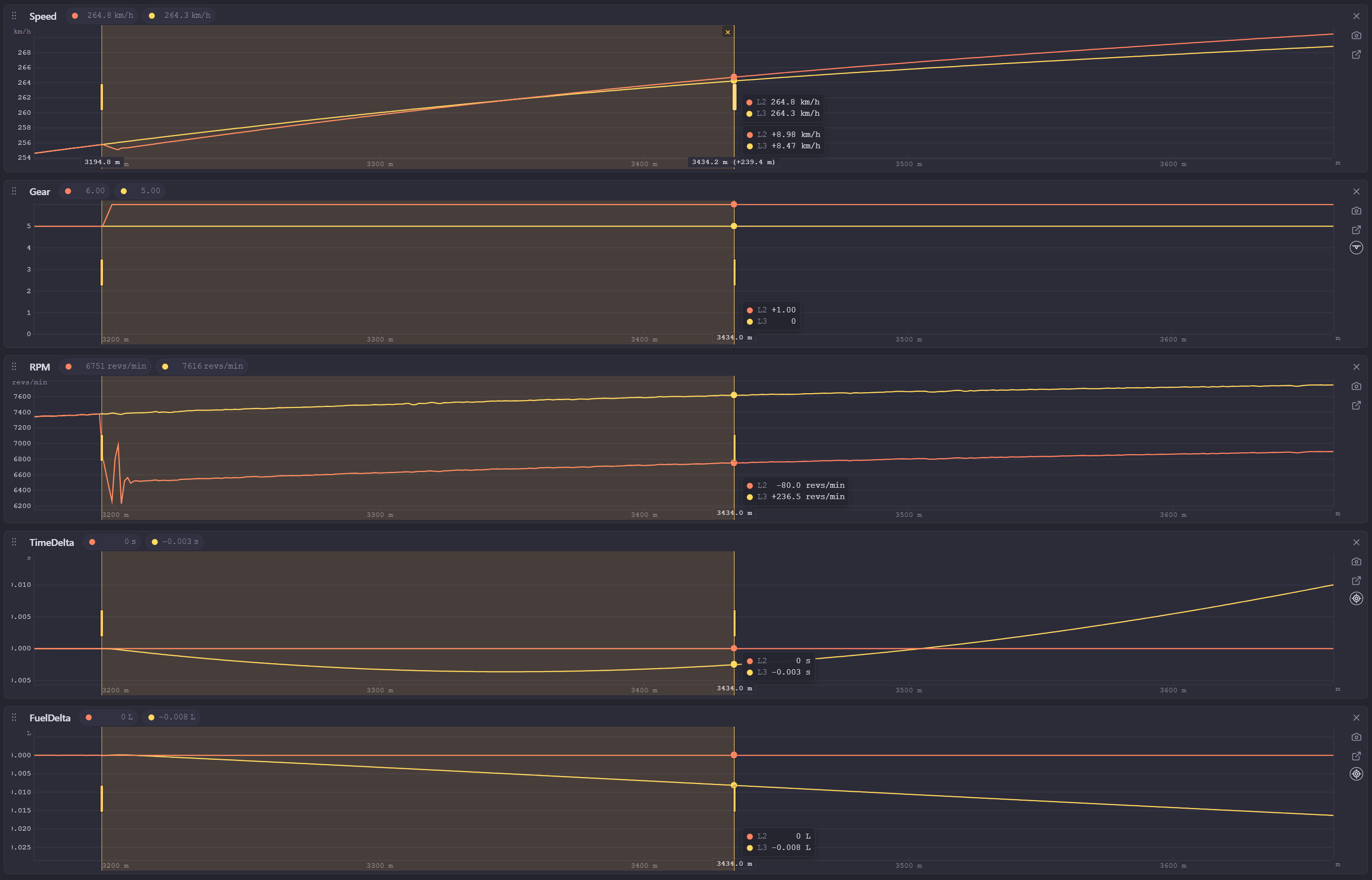
In the example above, 5th gear arrives at the braking zone ahead of 6th gear, at 265.9 km/h while 6th reaches 266.8 km/h. Lower speed means slightly less tire and brake load. It's only ~1 km/h, so it's tiny, but it's real and it favors holding 5th gear.
Does the time saved actually matter?
On a single straight, barely: shifting at the usual optimal shift point will cost about 0.004 s — and that's the worst case scenario assuming your braking zone happens exactly at 267 km/h / 4.3 s after the shift. This is really tiny. But it's free and does not come with any penalty on fuel or tires — and it compounds. Over a full endurance race, getting this right is lap time you don't have to work for.
One caveat — setup matters, as well as environmental conditions (which includes wind, air pressure, whether the straight goes uphill or downhill). The story holds in general, but the exact threshold value may shift. 267 km/h is the threshold for iRacing's medium downforce setup; on the iRacing High downforce setup the break-even moves to about 265 km/h; on the iRacing Low downforce setup (which uses different gear ratios) the break-even is at 273 km/h (vs an optimal shift at 266 km/h). At Spa, between the ideal shift point and the braking zone, altitude increases by 12m, so speed increases more slowly and numbers are different (hint: do not shift to 6th!). Always check your own setup and conditions before trusting a hard number. 265-267 km/h is a safe range to remember for the Ferrari 296 GT3 on iRacing.
But the same rule of thumb always applies for the Ferrari 296 GT3: avoid shifting to 6th gear if your optimal shift point is less than 4 s from your braking zone — 4 s is roughly the time it takes to accelerate from the 7350 rpm shift point (~257 km/h) up to 267 km/h, and is a more stable value that depends less on conditions.